



About the Program
NALSAR University of Law started the Access to Justice for Prisoners Programme in 2024. This is a systematic extension of the Prison Legal Aid Clinic Program run by the university since 2018. We provide qualitative free legal aid to the under-trial prisoners in Telangana. We support prisoners from vulnerable socioeconomic backgrounds. Through a systematic and holistic intervention by a team of trained and dedicated advocates, social workers and law students, the program addresses the constitutional goal of access to justice for all, irrespective of their socioeconomic status.
The program provides its services to the prisoners at the Central Prison of Chenchalguda, Central Prison of Cherlapally, Special Prison for Women at Chanchalguda and the children in custody of the juvenile justice department in Hyderabad. We are a dedicated team of advocates, social workers, researchers, students and interns who provide essential qualitative socio-legal services to the prisoners and their families. We collaborate with prisons department, State and District Legal Services Authorities, Legal Aid Defence Counsels, pro bono advocates, juvenile homes and provide end-to-end legal aid services until they are released.
Through visits to prisons and observation homes, we have reached over 1200 undertrial prisoners and children in conflict with law and successfully released over 180 of them. Our team supports the prisoners and their families to navigate the complexities of the bail process. Through our guidance and support, we aim to alleviate the stress and uncertainties faced by the prisoners.
The Prison Legal Clinic of the University serves as a platform for practical training, research, and support to strengthen the initiatives of the Prison Justice Program. Through this collaboration, NALSAR University leverages its expertise to enhance the effectiveness and impact of the program, ensuring the equitable delivery of justice to incarcerated individuals.
Our Philosophy
We at the Access to Justice for Prisoners (AJP) Programme believe justice as public good and hence legal aid is not charity but a constitutional and moral entitlement. We affirm that access to justice must be available to all, including those behind bars. By removing socioeconomic barriers, we operationalise the idea that justice should not be contingent on wealth, privilege, or social standing. We believe that even in incarceration, individuals retain their fundamental rights. We insist that imprisonment does not strip a person of their entitlement to fair legal representation. We see legal aid as a tool of empowerment, enabling prisoners to challenge unlawful detention, seek bail, and assert their rights in a system that often marginalises them. Beyond adversarial litigation, we recognise the law’s role in rehabilitation, reintegration, and ensuring humane treatment of citizens in conflict with law. In short, we believe in justice without discrimination, dignity without exception. Our goal is to realise constitutional morality in practice by bridging the gap between abstract rights and the lived realities of the most marginalised.
Research and Collaboration
The Access to Justice for Prisoners Programme, in collaboration with Centre for Constitutional Law, Policy and Good Governance, Indian Journal of Constitutional Law (IJCL), India Justice Report, Judicial Academy and Juvenile Justice Department of Telangana government organized several program in the past one year. The details are as follows:
- National Conference on Dignity Law organized by Centre for Constitutional Law, Policy and Good Governance, Access to Justice for Prisoners Programme & Indian Journal of Constitutional Law (IJCL), NALSAR University of Law on 5–6 July 2025
The National Conference on Dignity Law: Promise and Practice sought to critically engage with the principle of human dignity as a constitutional value and its application in Indian jurisprudence. Dignity, enshrined in the Preamble of the Constitution, has been invoked since Kharak Singh v. State of Uttar Pradesh (1963) and expanded in subsequent judgments, including Puttaswamy, to encompass privacy, shelter, sexual autonomy, liberty, and protection against torture. Yet, its invocation remains selective, lacking consistency and principled adjudication, leaving gaps in protection against procedural violence, state neglect, and institutional exclusion.
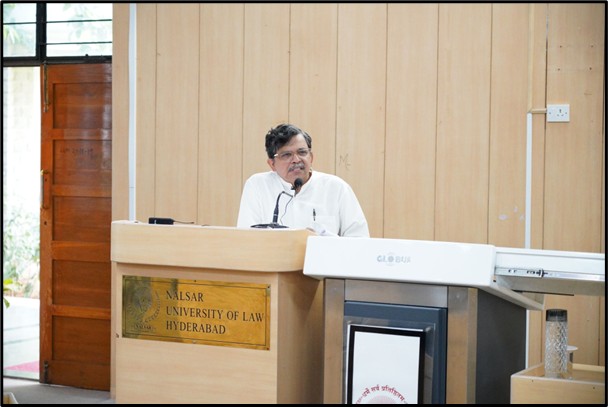
Justice Muralidhar (retd) giving inaugural address in Dignity Law Conference
Research and Collaboration
The Access to Justice for Prisoners Programme, in collaboration with Centre for Constitutional Law, Policy and Good Governance, Indian Journal of Constitutional Law (IJCL), India Justice Report, Judicial Academy and Juvenile Justice Department of Telangana government organized several program in the past one year. The details are as follows:
- National Conference on Dignity Law organized by Centre for Constitutional Law, Policy and Good Governance, Access to Justice for Prisoners Programme & Indian Journal of Constitutional Law (IJCL), NALSAR University of Law on 5–6 July 2025
The National Conference on Dignity Law: Promise and Practice sought to critically engage with the principle of human dignity as a constitutional value and its application in Indian jurisprudence. Dignity, enshrined in the Preamble of the Constitution, has been invoked since Kharak Singh v. State of Uttar Pradesh (1963) and expanded in subsequent judgments, including Puttaswamy, to encompass privacy, shelter, sexual autonomy, liberty, and protection against torture. Yet, its invocation remains selective, lacking consistency and principled adjudication, leaving gaps in protection against procedural violence, state neglect, and institutional exclusion.
Team

Dr. Murali Karnam
Designation: Professor of Human Rights & Director, AJP
Saranga Ugalmugle
Designation: Programme Coordinator