- Published On:
-
13 Oct 2026
-
Filed Under:
-
University Initiative
Report tracks regulatory developments in 57 jurisdictions and identifies pathways for strengthening India’s online child safety framework.
As India considers new approaches to children’s online safety, NALSAR University of Law, Hyderabad, and the Indian Governance and Policy Project (IGAP) have published a new report examining the regulatory choices facing the country. The study finds that social media age restrictions alone cannot address the full range of risks children encounter online.
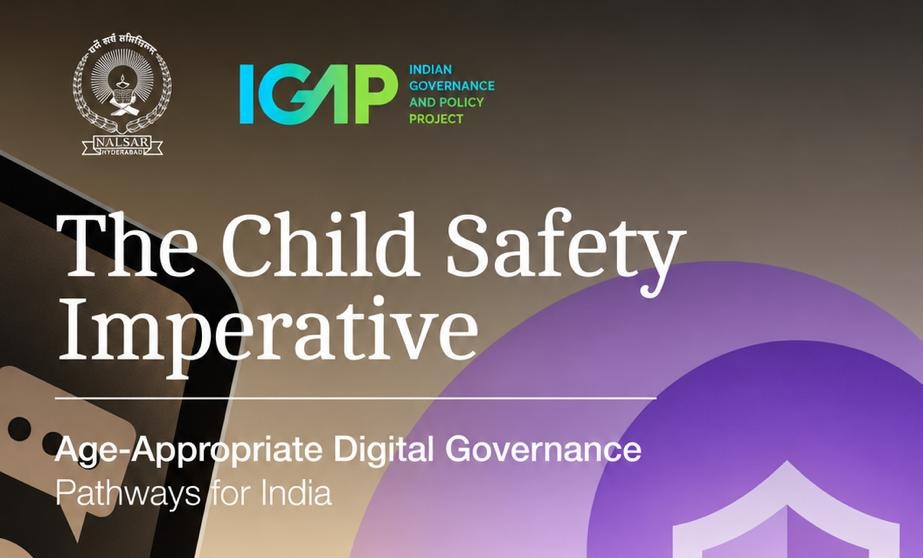
Titled The Child Safety Imperative: Age-Appropriate Digital Governance Pathways for India, the report maps regulatory developments across 57 jurisdictions, reviews evidence on child and adolescent development and digital wellbeing, and examines gaps in India’s legal and regulatory framework.
The study finds that while Indian laws provide protections against online exploitation, abuse and other serious offences, they are less equipped to address emerging risks associated with algorithmic recommendations, persuasive design, behavioural profiling and excessive engagement.
Professor (Dr.) Srikrishna Deva Rao, Vice-Chancellor, NALSAR University of Law, said, “Children’s online safety cannot rest principally with children and their families. Parents and schools have an essential role, but digital platforms must also be designed and governed responsibly. Effective protection requires capable institutions, meaningful oversight and safeguards that respect children’s privacy, rights and evolving capacities. We hope this report will provide a useful evidence base for governments and policymakers as they consider new regulatory measures and develop a more coherent approach to online child safety in India”
The report examines contrasting regulatory approaches across countries including Australia, Brazil, Indonesia and Malaysia. It finds that while minimum-age restrictions may form part of an online child safety framework, their effectiveness depends on implementation, complementary safeguards and the capacity to address risks arising from platform design.
Shachi Solanki, Director, IGAP, and Lead Author, said, “Our research highlights an important distinction between regulating children’s access to social media and making their digital experiences safer. For India, the priority should be to ground policy in evidence on child and adolescent development and the risks they encounter online, and to develop safeguards that are effective, proportionate and responsive to their evolving needs and capacities.”
The report recommends that India consider a dedicated, principle-based online child safety framework combining age-appropriate protections, responsible platform design, privacy-preserving age assurance and stronger institutional accountability. It also emphasises investment in regulatory capacity, digital literacy and India-specific research.
The study calls for an approach that protects children without unnecessarily restricting their access to information, education and beneficial digital services.
Click Here for a Snapshot of the Report
Click Here for the Full Report