
Aparesh Kumar Singh
Designation: Chief Justice
Department: High Court for the State of Telangana



The National Academy of Legal Studies and Research (NALSAR) was established in 1998 by a Statute of the State of Andhra Pradesh. Since its inception, the University has been home to vital conversations on law and justice. These conversations have acknowledged that questions of justice arise in all legal pursuits whether in the world of courts, corporations, education or administration. Using law as an instrument of social change the University has supported crusades for land rights, disability empowerment, prisoner’s rights and LGBTQIA+. NALSAR is committed to the creation of an ethical legal culture, which protects and promotes the rule of law. The University believes that the cause of building a rule of law society is a continuous enterprise, which is sustainable if it is undertaken with optimism and good cheer.
With students admitted from all over the country and faculty drawn from home and abroad, NALSAR is counted amongst the top law schools of the country. We are proud of the position but do not see it as defining us. In accord with its liberal outlook, legal education is imparted in an inter-disciplinary manner. Consequently, there is convergence between the disciplines of law, social sciences, humanities, and management studies in both developing and executing the curriculum in the various degree and diploma courses. Teaching we believe becomes monotonous and mediocre unless accompanied with both theoretical and empirical research. A symbiotic relationship between teaching and research has thus been proactively forged in the operation of the academic programs.
The University in all its years of existence has attempted varied strategies to create a vibrant scholastic environment. We continue in honest reflection on what works and what does not as we strive to realize our aims and objectives.
To provide quality legal education that underlines constitutionalism, rule of law and justice, with a particular focus on social justice to the marginalized communities.
To so impart legal education, conduct research and training, undertake writing and publication, disseminate information and promote legal literacy, that the vision of the university informs its reality.
Designation: Chief Justice
Department: High Court for the State of Telangana
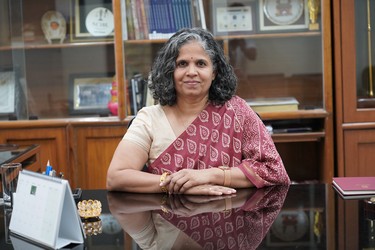
The Honourable Justice Aparesh Kumar Singh became the Chief Justice of the Telangana High Court following 13 illustrious years on the bench, first at the Jharkhand and then at the Tripura High Courts. Before being elevated to the bench, Justice Singh practised at the bar in Patna and Jharkhand. As the Chancellor of NALSAR, the Honourable Chief Justice chairs the General Council, the plenary authority of the University that is entrusted with formulating and reviewing its broad policies and programmes.

Designation: Vice-Chancellor
Designation: Registrar (I/c)
The functioning of the University is managed through organisations established in the statute as well as bodies created to implement the statute. These bodies have been so designed that relevant stakeholders and impartial experts can deliberate and decide key concerns of university policy. The following have been created by the NALSAR Act:
General Council is the plenary authority of the University entrusted with formulating and reviewing, as and when necessary, the broad policies and programmes. The membership of the body encapsulates for the outside world the strength of NALSAR as an institution:
The following constitute, with the Chancellor as chairperson, the General Council:
It is the Chief Executive Authority of the University, body entrusted with all powers necessary to administer the University. It has a sizeable representation of senior government officials so as to add expertise in nuances of administration to our strong academic set-up.
The Executive Council consists of:
This body has the chief responsibility of keeping NALSAR a step ahead of others in the field of legal research and education by means of ensuring that the academic planning is not only forward looking but also holistic; and thus strive to provide the very best in legal education in the nation. It works under the overall supervision of the Executive Council.
The Academic Council is comprised of:
This body is tasked with maintaining both efficiency and propriety and to ensure that the fiscal affairs of the university are undertaken in accordance with the norms of financial management.
The Finance Committee consists of: