


Milon K Banerji Centre for Arbitration releases “Arbitrator Appointment in Numbers” Report
- Published On:
- 10 Oct 2026
- Filed Under:
- University Initiative
The Milon K. Banerji Arbitration Centre (MKBAC) at the NALSAR University of Law, Hyderabad released its empirical report, “Arbitrator Appointments In Numbers”, on 10 October, 2026. The report studies appointment orders under Section 11 of the Arbitration and Conciliation Act, 1996 in petitions filed in 2025 before the Supreme Court, the High Court of Delhi (DHC) and the High Court of Bombay(BHC). The study covers 3,688 unique cases, with data collected up to June 30, 2026. These include 65 cases before the Supreme Court, 1,923 before the Delhi High Court and 1,700 before the Bombay High Court. The key findings of the study include:
- Court appointments are concentrated among a relatively small group of arbitrators. Of the 1,060 arbitrators appointed by courts, 54 arbitrators (5.09%) received seven or more appointments and together accounted for 24.00% of court-made appointments. At the BHC, 11.21% of arbitrators received 38.24% of court-made appointments, with one arbitrator receiving as many as 34. The dataset does not establish that repeat appointments are improper, preferential, or indicative of bias.
- Section 11 proceedings involve materially different degrees of contestation, but are subjected to the same judicial process. Of the 2,709 appointments, 47.14% were made by consent, 35.36% were ex parte, and only 17.50% were contested. Thus, 82.50% of appointments did not involve a substantive contest.
- The appointed arbitrator pool shows significant gender and professional concentration. Of the 2,283 appointments for which gender was recorded, 70.03% were male and 29.97% were female. Of 2,284 appointments where the profession was recorded, 73.21% were advocates, 23.73% were retired judges, and only 3.10% were technical experts.
- 626 cases, representing 16.97% of the cases, took more than six months for disposal from the date of the first order. On average, disposal took over 163 days in the SC, 85 days in DHC, and 111 days in BHC.
- This delay is not predominantly attributable to court-related factors. Of the orders recorded in delayed cases, 56.87% were attributed to the conduct of the parties and to notice and service, compared with 26.89% attributed to listing and court related delay.
- Institutional appointments are unevenly distributed across courts. The BHC delegated the selection of the arbitrator to an arbitral institution in 26.74% of its appointments, spread across seven institutions. The DHC did so in 5.19% of cases and only ever to DIAC, though the DIAC Rules were referenced in 79.39% of its appointments.
- Mediation is infrequently used at the Section 11 stage and is associated with both settlement and delay. Only 4.80% of cases were referred to mediation. In the DHC data, mediated cases settled at 21.14% compared with 3.55% for unmediated cases, but were delayed at 48.99% compared with 16.12%.
Recommendations
Key policy recommendations from the report include:
- There should be a differentiated procedural structure for Section 11 applications, with separate routes for consent, ex parte, and contested appointments.
- Routine matters should be eligible for expedited disposal, while contested applications should receive focused judicial consideration.
- Section 11 applications should contain, at the time of filing, the key information and documents necessary for the Registry and the Court to determine the nature of the application, and courts should establish a clear service protocol.
- Courts should maintain a central record, at the national level, of court-made appointments showing an arbitrator’s recent and concurrent appointments, and that courts and arbitral institutions broaden their pools of eligible arbitrators.
- The report also suggests an organization that could provide administrative / secretarial support to ad hoc arbitrators and a mechanism to review the timeline and overall conduct of court-referred arbitrations.
- There should be a short and clearly defined settlement window, rather than an open-ended referral, for mediation at the Section 11 stage.
Click Here for the Full Report
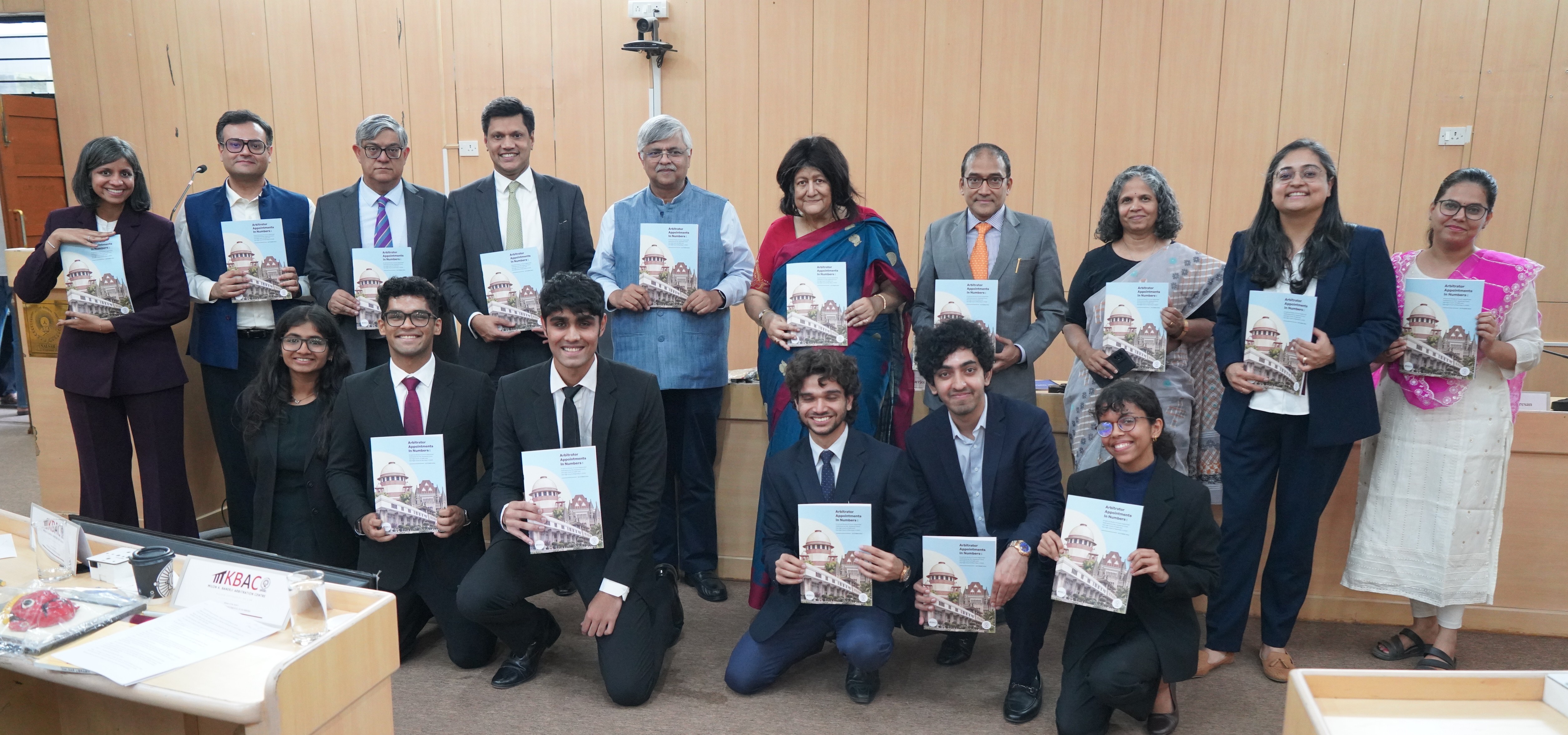
At the Launch
Prof. N. Vasanthi, Registrar of NALSAR, delivered the welcome address, and Mr. Gourab Banerji, Senior Advocate, Donor and Patron of MKBAC, gave the opening remarks. Research Scholars Zorawar Almeida, Hamza Khan and Arnav Mathur presented the Centre and the methodology. Associate Directors (Research) Shreya Parikh and Chand Chopra presented the findings.
A panel discussion followed with Hon’ble Ms. Justice Indira Banerjee (Retd.), Hon’ble Mr. Justice Prateek Jalan, Hon’ble Mr. Justice Somasekhar Sundaresan and Mr. Ritin Rai, Senior Advocate and Co-Chair of MKBAC. Dr. Amit George, Director (Research), delivered the vote of thanks.